

Hey everybody, it's been awhile since my last blog post. I've had lots of ideas for new blog posts but my interests have been shifting gears all over the place for the last couple of months and I hadn't been able to focus on the blog. First off, my blog had its one-year birthday back in March and I was going to do a contest give away to celebrate but it slipped past so quickly and never got around to it. So keep an eye out for that because it's coming real soon.
Hang on a sec, I gotta go look through my G+ feed to see
everything I was doing 9 weeks ago.
Ok, I'm back. Some of the blog ideas I had in mind are Dark Places
& Demogorgons from Bloat Games, The Fall of Delta Green from Pelgrane
Press, White Box Fantastic Medieval Adventure Game by Seattle Hill Games,
Leagues of Gothic Horror by Triple Ace Games, Saga of the Goblin Horde:
Countdown deck from Zadmar Games, White Star: Galaxy Edition and The Hero's
Journey Fantasy Roleplaying from Barrel Rider Games, Wrath and Glory from
Ulisses Spiele, Cartoon Action Hour from Spectrum Games, For Coin & Blood
from Gallant Knight Games, Astonishing Swordsmen And Sorcerers Of Hyperborea from North Wind Adventures, The Pirates Guide to Freeport from Green Ronin, I
was a guest on the Finding the Narrative podcast, I also worked with Pete
Spahn on a GM aide for WWII: Operation Whitebox, and I did some cartography for
the Undead Island module from Cyclops Games.
Whew, as you can see I was all over the place the last two months. If you couldn't tell from the blog title, I've been looking at OSR games
more frequently over the past couple of months (if that title doesn't make you think of the Beatles then you're lame brah!) For those that don't know, OSR stands for Old School Renaissance,
Old School Revival, or Old School Roleplaying depending on who you talk to.
This is an idea of going back to the roots of fantasy role playing. As I delved
deeper into OSR I learned that I've played some of these games not realizing
they were categorized as OSR. Particularly a game I ran for close to a year
falls into this category. Castles & Crusades, which I've blogged about in
the past uses the SIEGE Engine mechanic. Another OSR game I've wanted to play
but never did was Swords & Wizardry (S&W). Instead I
"borrowed" lots of S&W content to use in my C&C game. The
great thing about OSR is that most if not all of the modules and creatures are
cross compatible.
Hmmm. I think this is going to be a rather lengthy post.
As I was looking more into these OSR games I started wondering
what is so different from one to the next. Do I need OSRIC (Old School
Reference and Index Compilation), Labyrinth Lord, S&W, C&C, White Box,
AD&D, or any of the other retro-clones out there? For those that haven't
looked into it, there is a big list of games out there. So, what’s the
difference between them? Basically, what it comes down to is which one suits
you best. Each one is attempting to clone the best parts of some version of
D&D and insert their own "house rules".
In order to figure out what the retro-clones are trying to
emulate, we must first look at the progression of the D&D books. First
there was Gary Gygax and Dave Arneson. They wrote the original 3 Dungeons &
Dragons volumes (OD&D) or white box as it is commonly referred to. Then
that was followed up with 5 supplements. These OD&D supplements are
Greyhawk, Blackmoor, Eldritch Wizardry, Gods Demi-Gods and Heroes, and Swords
& Spells.
Next up is the Basic Set. This particular set gets a little
confusing as there were multiple versions released. The first version of
Dungeons & Dragons Basic Set is written by John Holmes, a few years later
Tom Moldvay writes one. Around the same time as Moldvay, David Cook comes along
and authors the Expert Set. This is commonly called B/X (Moldvay Basic/Cook
Expert). A couple of years later Frank Mentzer comes out and writes a whole
slew of stuff. First, he writes the Basic Set (commonly called the Red Box),
then he writes the Expert Set, the Companion Set, the Master Rules, and the
Immortal Rules. These 5 items from Frank Mentzer are commonly referred to as
BECMI.
At the same time the Dungeons & Dragons Basic Set was
released, TSR also carried a second line of D&D. This was called Advanced
Dungeons & Dragons (AD&D). AD&D had many books and supplements from
1977 on through to 1988. In 1989 Advance Dungeons & Dragons Second Edition
is released. Then in 2000, the 3rd edition comes out closely followed by v3.5
which lasted until the 4th edition is released in 2008. That finally brings us
to the current 5th edition released in 2013.
I know, it’s all very confusing when talking about the early
versions of D&D but hopefully this has helped someone figure out what the
folks in the OSR community are talking about.
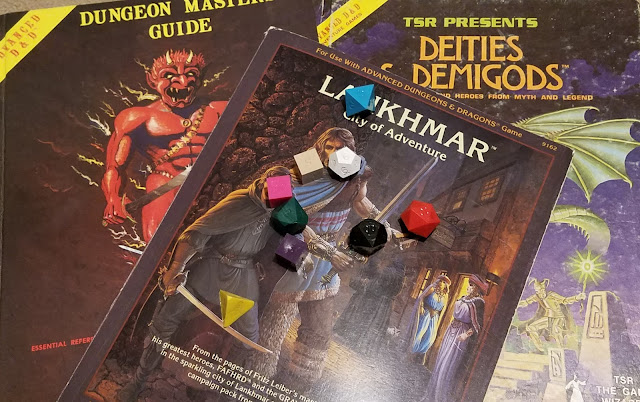

Now we can start looking at some of the books in question. I don't
own OSRIC or Labyrinth Lord so I can't really comment on them but from what I
understand, OSRIC is most like AD&D (1st edition for the lay folk) and
Labyrinth Lord is considered a B/X clone. Let's start with the one I know
fairly well. C&C is modeled after 3rd edition but has an AD&D feel to
it. I haven't quite figured out why it feels this way but it does and I like
it. I don't know if I ever mentioned this before but I cut my RPG teeth on
AD&D. My older brother Rob, DM'd for my friend Brian and myself around the
age of 8 or 9. Several years ago I attended GaryCon with some friends and I was
hooked on C&C ever since. During that same convention I also played in a
game of AD&D run by Weird Dave. That was a great game but it reminded me of
some of the shortcomings of AD&D. Namely the armor class system. First of
all, let me say that I don't like the descending armor class system. THAC0
never made much sense to me whatsoever. I was very excited to see 3rd edition
removed it in favor of the ascending armor class. Thank you, Skip Williams,
Monte Cook, and Jonathan Tweet.
Shortly after purchasing tons of Troll Lord Games supplements, I
was running out of published modules to use and quite frankly, I was learning that published modules weren't always very well written or even very useful for me and my group. What was I to do? I started
looking around and realized that all of the OD&D, AD&D, and S&W
stuff could easily be converted to C&C. In some cases, I didn't even need
to do any conversion at all. So, the next year at GaryCon I was looking around
the dealer hall and I came across a booth that said Frog God Games. While
perusing the S&W products I talked to the sales man, who sold me on Rappan Athuk and boy did I buy into it. This is one
hell of a mega dungeon let me tell you. Anyway, I'm digressing. Back to the
conundrum at hand.
All of this was several years ago and then I recently came across
WWII: Operation Whitebox from Small Niche Games. You can read about that in my
previous post. This game made me realize how simple it is to adapt this so
called White Box game. So, I did some digging around and found the White Box
Fantastic Medieval Adventure Game written by Charlie Mason which is based on
the Swords & Wizardry White Box. Say what? I knew all about S&W but I
never heard of a S&W White Box. Well, Charlie did a damn good job with his
interpretation. So much so that I went and bought a hardcover from Lulu. This
really breaks down the game and I don't think I would want anything simpler
than this in my library. I highly recommend you check out Mr. Mason's White Box
game.
This brings up another interesting topic, how simple of a rule system is too simple? This will be a good topic for another post so I'll leave it at that.
So now that I'm looking around at other OSR rule books, the question comes in. What makes them so different that I should get multiple books and play them all? I don't honestly think I can answer that question. Some people are trying to over simplify the games to the point where when I read the first 20 pages I'm like UGHH. It's wayyyy too simple for my tastes, I need more. Fortunately, lots of these books are free pdf downloads, so you can read them yourself and decide if you want to spend money on a printed copy.
Whilst I was perusing the OSR Google communities I also came across a post about someone finally getting the last signature needed in his DCC book. In the picture he posted were two hats alongside the book. I thought wow, those are cool. Now this isn't the first time I've seen those patches but I had no idea where anyone is getting them. I did a little digging around and finally found a blog post that talked about Thaddeus Moore's patches. Tenkar's Tavern did a great write up about it so I'm not going to re-write it. Check it out here.


The person who posted that picture also got me thinking about DCC. I guess I never really thought about DCC as an OSR game. I've had the pdf for some time now and only looked at it for the artwork thus far. It makes perfect sense now though. The art is definitely reminiscent of the black and white line art style we all know and love. Crap, more OSR stuff to start thinking about.
Ooh yeah, I also found these bad boys over on Etsy. Check it out here.

At this rate, I don't think this blog post is ever going to end so I'm gonna call it quits here. I think I've got at least two more posts on this subject coming because I didn't even come close to answering the original question I had and it is such a broad topic. Another question I have is what defines a game as OSR? I don't think this is an easy and straight forward question either. Damn, this post is FUBAR. Well, at least I'm sticking to the moniker of my blog title. These are absolutely random thoughts.
Be sure to head over to the Nerds-International Google + community and don't forget about NIV Con on September 15th and 16th. You don't need to be a member to sign up to run or play in games. So head on over to the sign up page here. I look forward to hearing some new voices or even seeing new faces during the online convention.


